.png)
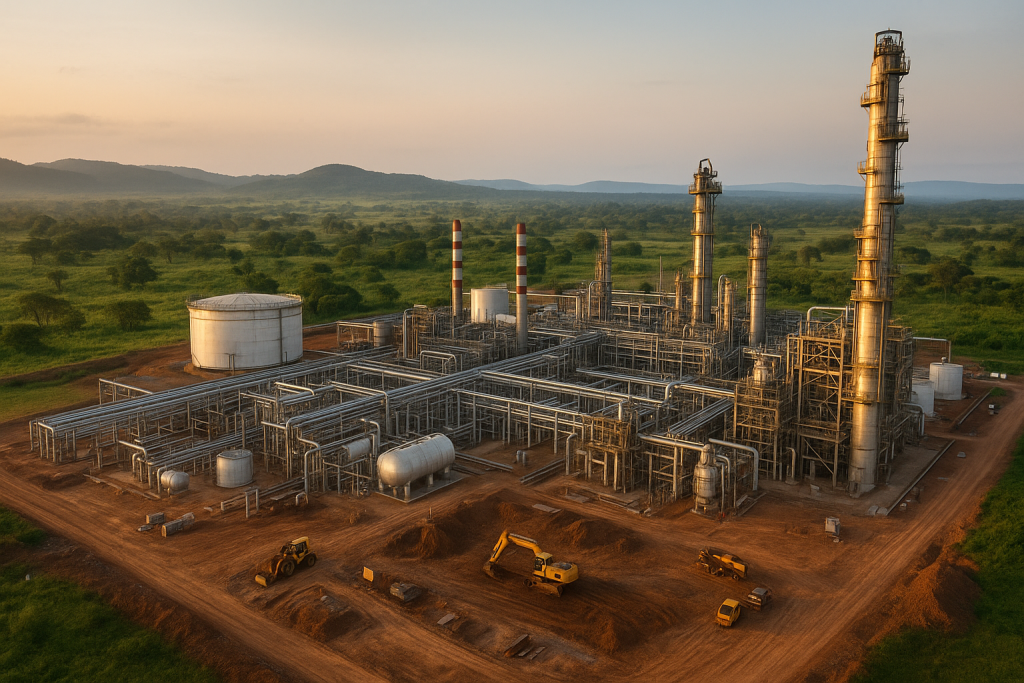
Zambia imports 100 percent of its petroleum products, exposing the country to supply shocks and volatile pump prices. A private oil refinery in Zambia can close this gap, strengthen energy security, and unlock new revenue streams for investors.
Why a Domestic Refinery Makes Sense
-
Energy security: Local refining reduces dependence on imported finished fuels.
-
Cost stability: Processing crude at home cushions the market against freight and currency swings.
-
Industrial growth: Ancillary industries—chemicals, logistics, maintenance—gain fresh demand.
-
Job creation: Construction and operations create thousands of skilled and semi-skilled jobs.
Market Demand Snapshot
Petroleum consumption rose from 1.8 billion L (2021) to 1.9 billion L (2022) and is forecast to climb steadily with GDP growth exceeding 6 percent in 2025. Diesel and gasoline together account for more than 80 percent of inland demand, making a 30 000–50 000 barrel-per-day (bpd) refinery commercially viable.
Capital & Operating Costs
| Item | 30 000 bpd Estimate | Notes | | CAPEX | US $450 m – US $750 m | Range reflects technology choices and local infra upgrades. | | Annual OPEX | US $3.5 m – US $5.3 m | Includes staff, catalysts, utilities, maintenance. |
Smart design—energy-efficient heaters, waste-heat recovery, digital control systems—keeps operating costs at the low end of the range.
Licensing & Regulatory Steps
-
Company incorporation with PACRA.
-
Refining licence from the Energy Regulation Board (ERB).
-
Storage & distribution licences for depots and bulk trucks.
-
Environmental Impact Assessment (EIA) approved by ZEMA (6–9 months, public hearings required).
-
Tax registration with ZRA; apply for ZDA investor incentives (e.g., duty-free capital imports).
A well-prepared dossier—technical drawings, risk assessments, proof of financing—shortens review times dramatically.
Environmental & Social Compliance
Refining is emission-intensive. Early mitigation measures—low-NOx burners, sulphur-recovery units, spill-containment basins, community benefit programs—protect the project’s “social licence” and avoid costly redesigns later.
Technology & Site Selection
-
Configuration: A hydroskimming-plus-conversion set-up balances cost and product flexibility, upgrading heavy gas oil to high-value diesel.
-
Location: The Ndola industrial corridor offers road-rail links, access to the TAZAMA pipeline, and an experienced energy workforce.
-
Utilities: Secure water (≈1 m³ per bbl) and 24/7 power—cogeneration with refinery off-gases can cover 60 percent of electricity needs.
Financing Options
-
Development banks: Afreximbank’s US $3 bn oil-trade window can underwrite crude purchases.
-
Public–private partnership: A joint venture with Government accelerates land access and permit clearances.
-
Equity + debt: A 40:60 equity-to-debt structure is typical; multilateral guarantees lower interest spreads by 150–250 bps.
-
Strategic offtake: Pre-sales to mining houses or transport operators secure cash-flow visibility, pleasing lenders.
Profit & Payback Forecast (30 000 bpd)
| Refining Margin | Annual Profit (Yr 5) | 10-yr Cumulative Profit | Payback | | US $5/bbl | ~ US $40 m | US $352 m | 17 yrs | | US $8/bbl | ~ US $65 m | US $599 m | 10 yrs | | US $12/bbl | ~ US $98 m | US $925 m | 6 yrs |
Margins in sub-Saharan markets averaged US $10.4/bbl in Q1 2025, suggesting medium-to-high scenarios are realistic.
Key Risks & Mitigation
| Risk | Mitigation | | Feedstock price spikes | Long-term crude contracts, hedging. | | Permit delays | Early regulator engagement, specialist advisors. | | Cost overruns | EPC lump-sum-turnkey contract, performance bonds. | | FX volatility | Dual-currency loan mix, natural USD revenues. | | Community opposition | Transparent stakeholder plan, local hiring. |
12-Month Action Plan
-
Commission feasibility study (market, technology, ESIA).
-
Secure land options and initiate baseline environmental studies.
-
Engage ERB & ZEMA for pre-application guidance.
-
Line up cornerstone investors and draft term sheets.
-
Issue EPC request for proposals with local content targets.
-
Submit full licence applications with financial closure evidence.
Conclusion
A private oil refinery in Zambia demands patience and capital, yet the commercial and developmental rewards are compelling: energy independence, robust margins, and durable economic impact. With disciplined execution and stakeholder alignment, investors can break ground in as little as 24 months and achieve payback within a decade.