.png)
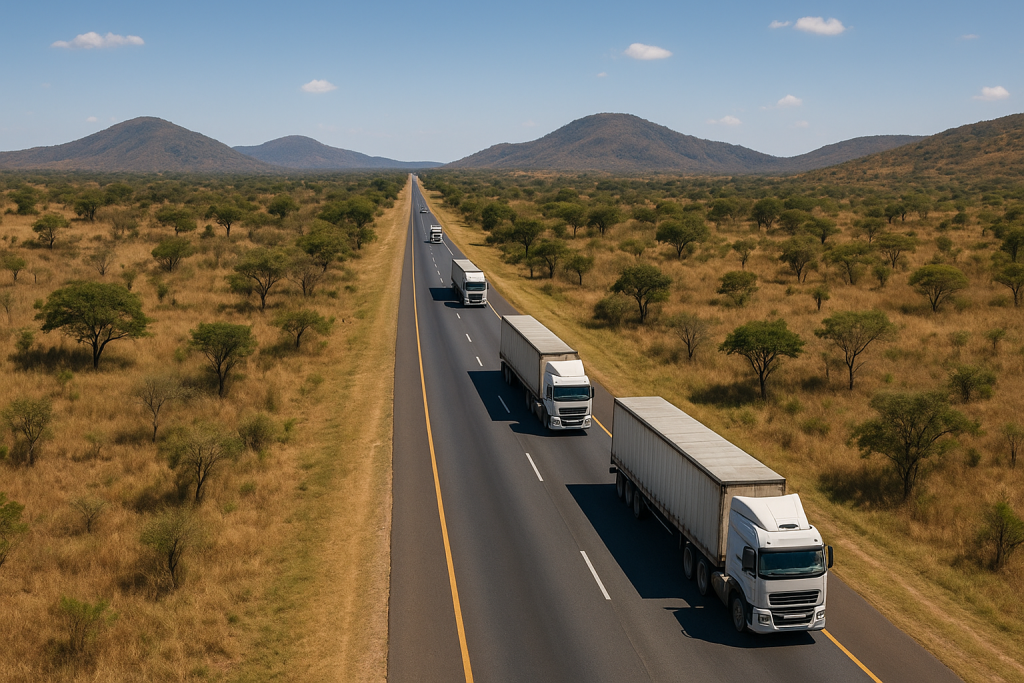
Zambia’s haulage industry is at a digital crossroads. By pairing the Great North Road with telematics and fleet-management software in Zambia, operators can slash costs, improve safety, and deliver goods faster. Studies show freight expenses can add up to 40 % of a product’s landed price—a burden that cripples competitiveness.(parliament.gov.zm) Meanwhile, the National Digital Transformation Strategy 2023-2027 positions transport technology as a keystone of Vision 2030.(dig.watch) Early adopters already report double-digit fuel savings and 50 % fewer accidents.(frotcom.com)
1 The Great North Road: Zambia’s Trade Super-Highway
1.1 Economic Significance
Running 1,019 km from Lusaka to Nakonde, the T2 corridor links Zambia to Tanzania, the Port of Dar es Salaam, and the wider EAC/COMESA market.(eib.org) Every tonne that moves along its asphalt underpins mining exports, agricultural inputs, and retail supply chains.
1.2 Infrastructure & Operational Challenges
Poor pavement, limited weighbridge enforcement, and sporadic 4G coverage inflate transit times and accident rates. The government is upgrading 2G towers to 4G, yet long rural stretches still drop signals—an obstacle for data-hungry telematics units.(facebook.com)
1.3 Competitive Disadvantage
High freight tariffs, border delays, and empty back-hauls erode profit margins. For exporters, every extra kwacha spent on fuel or downtime chips away at regional price parity.
2 Telematics & Fleet-Management: The Digital Remedy
2.1 What Is Fleet Telematics?
Telematics fuses GPS, cellular data, and onboard diagnostics (OBD-II) to collect real-time information on location, speed, idling, fuel burn, and driver behaviour. Dashboards convert this data into actionable KPIs—ETAs, maintenance alerts, and route deviations.
2.2 Core Benefits for Zambian Operations
-
Fuel savings (10-20 %) through idling alerts and eco-route planning
-
50 % fewer accidents via driver-scorecards and real-time coaching
-
Predictive maintenance that cuts roadside breakdowns and cargo loss
-
Proof of delivery & cold-chain integrity to reassure international clients
-
Regulatory reporting on hours-of-service and emissions targets
Case in point: Access Logistics equipped 52 tankers with telematics and saw sharp drops in fuel theft and turnaround times.(frotcom.com)
2.3 Fuel Efficiency & Cost Optimisation
Fuel often represents 30-40 % of total operating cost. By monitoring harsh acceleration, over-revving, and unauthorised detours, managers recapture thousands of litres annually—vital when pump prices fluctuate.
3 Implementation Challenges & Solutions
3.1 Infrastructure Considerations
-
Connectivity gaps: Use SIMs that roam on Airtel, MTN, and Zamtel to minimise dead zones.
-
Power reliability: Install dual-battery or solar-assisted units for reefers and rural depots.
-
Data costs: Negotiate fleet-wide bundles; modern devices compress data packets.
3.2 System Integration & Adoption
Legacy ERP, warehouse, and TMS software may use different data schemas. RESTful APIs and middleware bridges allow telematics events to flow into accounting, payroll, and compliance modules, creating a single source of truth.
3.3 Best-Practice Deployment
-
Pilot 10 % of the fleet to secure quick wins and staff buy-in.
-
Train drivers with gamified leaderboards—reward safe driving.
-
Set clear KPIs (fuel / km, on-time delivery %) and review monthly.
-
Phase integrations, starting with maintenance, then dispatch, then finance.
4 Economic Impact & ROI
4.1 Quantifiable Benefits
| Metric | Pre-Tech | Post-Tech | Improvement | | Fuel cost / km | K 6.50 | K 5.25 | -19 % | | Accident frequency | 12 / year | 6 / year | -50 % | | On-time deliveries | 78 % | 93 % | +15 pp |
Most fleets recover their hardware and subscription spend within 12-18 months, thanks to fuel and maintenance savings alone.
4.2 Regional Success Stories
-
South Africa: Retailer Pick n Pay cut 15 % from annual transport spend after linking telematics to route-optimisation AI.
-
Kenya: Long-haul milk distributor used geofencing to reduce theft, boosting net margins by 8 %.
4.3 Long-Term Economic Benefits
Lower logistics costs ripple through the economy—exporters price competitively, SMEs access new markets, and carbon emissions fall. Digital fleets also create datasets that insurers, lenders, and customs can trust, reducing risk premiums.
5 Policy Framework & Government Support
5.1 Alignment with the National Digital Transformation Strategy
The 2023-2027 Strategy prioritises connectivity, digital skills, and e-logistics to meet Vision 2030’s inclusive-growth targets. Incentives include import-duty waivers on ICT hardware and venture-capital tax rebates.(mots.gov.zm)
5.2 Sector-Specific Policies
-
Road Transport & Safety Agency (RTSA): drafting electronic logbook rules.
-
Zambia Revenue Authority (ZRA): piloting smart-seals for bonded cargo.
-
Ministry of Transport & Logistics: funding weigh-in-motion and CCTV upgrades along the T2.
5.3 Regulatory Considerations
Operators must comply with data-protection laws (DP Act 2021) and secure end-to-end encryption for any cross-border data transfers, especially when servers sit outside COMESA.
6 Future Outlook & Strategic Recommendations
6.1 Roadmap for Fleet Owners
-
Audit current operations—fuel spend, downtime, incident logs.
-
Choose a scalable SaaS platform; insist on open APIs and local support.
-
Leverage financing schemes such as the Citizens Economic Empowerment Fund for ICT upgrades.
-
Partner with MNOs to co-site edge servers along signal-weak corridors.
6.2 Emerging Opportunities
-
AI-powered route optimisation factoring real-time traffic and weather.
-
Electric truck telemetry as Zambia expands hydropower and solar capacity.
-
Blockchain-backed e-BOL (electronic bill of lading) to streamline customs.
6.3 Collaboration & Partnerships
Universities can analyse anonymised trip data; insurers may offer usage-based premiums; mobile operators can bundle IoT SIMs with analytics dashboards. A public-private working group would accelerate standards and shared infrastructure.
Conclusion
The Great North Road’s next leap is digital. Telematics and fleet-management software in Zambia convert every kilometre into data, every litre into insight, and every delay into an opportunity for optimisation. By embracing connected-vehicle technology today, transport operators will not only cut costs but also drive Zambia closer to its Vision 2030 goal of becoming a truly land-linked economy.